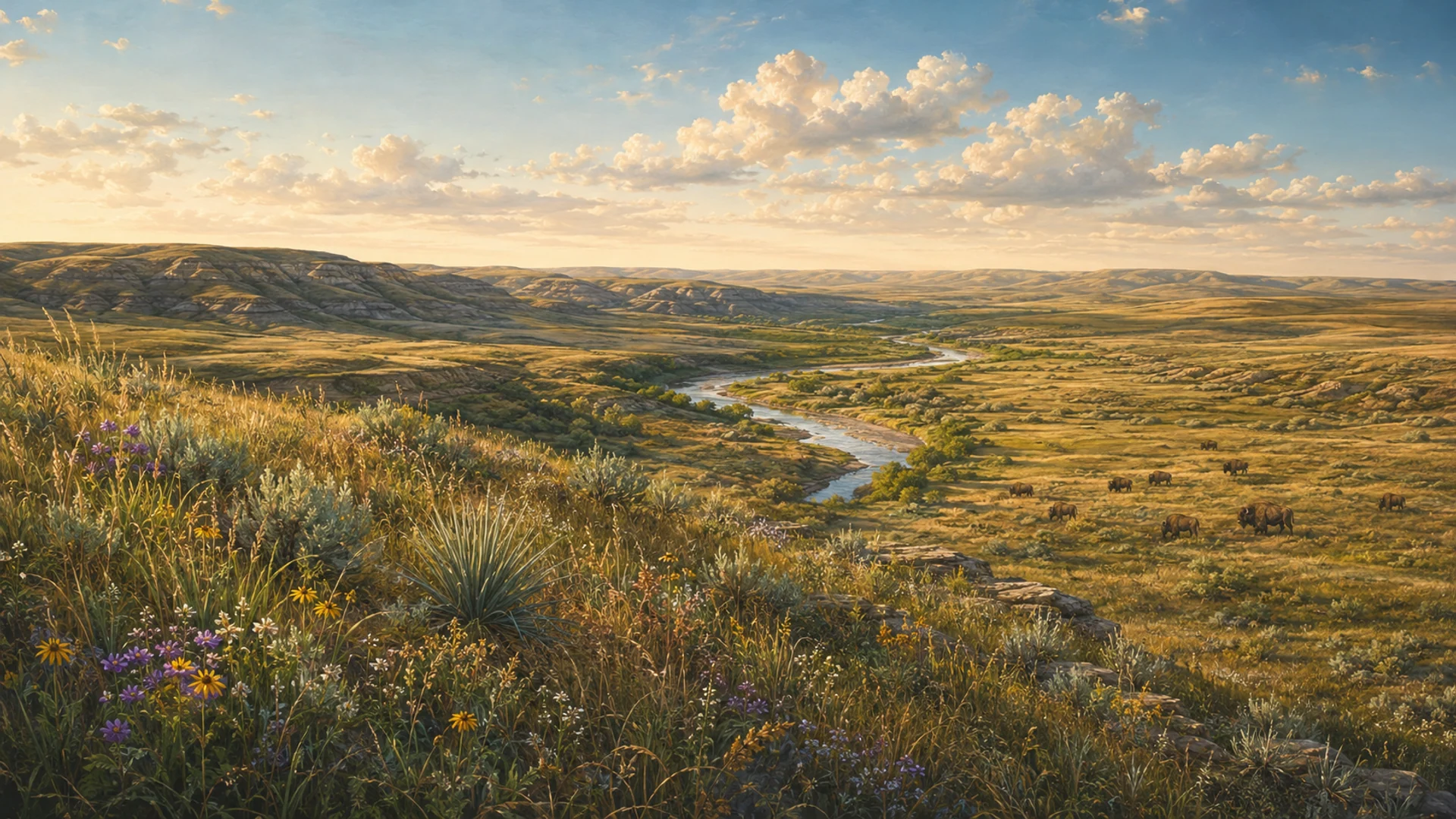
Grasslands National Park · Saskatchewan
Meet the
living prairie.
Follow deep roots, grazing bison, wind-shaped hills, and tiny new shoots into one of Canada’s most remarkable mixed-grass ecosystems.
PLACEGrasslands National Park
LANDSCAPEFrenchman River Valley
LIVING SYSTEMMixed-grass prairie
BIG IDEAEvery patch has a role
Read the grassland
Open country is full of hidden structure.
Grasslands National Park protects rolling uplands, coulees, creeks, and the Frenchman River Valley near the northern edge of North America’s mixed-grass prairie. Look closely and the “empty” view becomes a layered neighbourhood of grasses, wildflowers, sage, lichens, insects, birds, burrowing animals, and bison.
Find the chapter landscape
Southwestern Saskatchewan, two distinct park blocks.
The chapter’s bison, Frenchman River Valley, Ecotour Road, and Val Marie references place this adventure in the West Block. The map below uses Parks Canada’s current published cartography so the park boundary, access roads, river, trails, and visitor facilities remain geographically grounded.

The West Block visitor centre is in the village at Highway 4 and Centre Street.
Ecotour Scenic Drive descends into the Frenchman River Valley and links pull-offs, trailheads, Belza, and the campground.
Park access roads are gravel, cell service is unreliable, and wet conditions can change road travel.
 STOP · SCAN · GIVE SPACE
Family field habits
Make distance part of the discovery.
The safest wildlife moment is often the most interesting one. Binoculars reveal behaviour without changing it.
-
01
Stay at least 100 metres from bisonParks Canada describes this as about three bus lengths. Never approach or follow.
-
02
Keep the animal’s route openWatch from the side and never stand between wildlife and its direction of travel.
-
03
Prepare before leaving pavementCarry current maps, water, fuel, sun and storm protection, and check road conditions.
Official conditions, closures, fire information, access, and programs can change. Confirm them with Parks Canada before visiting.
A prairie in motion
Four forces shape this living landscape
Prairie resilience comes from relationships above and below ground, not from any single species working alone.
Water & landform
Coulees, creeks, and the Frenchman River create wetter niches within a dry landscape.
Roots & soil
Dense roots bind soil, store living tissue, and help grassland plants use scarce moisture.
Grazing & wallows
Bison create short patches, tall refuges, shallow wallows, hoofprints, and moving nutrients.
Fire & renewal
Carefully managed fire can support native plants, attract grazers, and reduce invasive growth.
The prairie below the prairie
Roots turn loose soil into living structure.
Mixed-grass prairie plants share space rather than forming one uniform lawn. Their varied roots and growing points create a tough underground network that helps the community hold soil, capture moisture, and respond after grazing.
- AnchorFibrous roots grip soil particles and slow wind and water erosion.
- StoreRoots and crowns keep energy and living tissue close to the ground.
- ShareDifferent species use water, depth, and seasons in different ways.
- RegrowMany prairie grasses can send up new leaves after a grazing bite.

Keystone grazers
Bison make a habitat mosaic.
Bison returned to the West Block in 2005 after more than 120 years away. Grazing, trampling, dung, and wallowing help create varied prairie patches used by different plants and animals.

Shortens selected patches.
Opens shallow soil basins.
Moves nutrients across the range.
Creates a varied patchwork.

Repair takes patience
A prairie is planted in seeds
and rebuilt in relationships.
Parks Canada reports that its vegetation restoration program has restored 1,133 hectares of previously cultivated land to varying degrees of success. The work can include controlling non-native plants, preparing sites, sowing native seed mixes, adding shrubs or wildflowers, and monitoring what establishes.
Native prairie does not return on a deadline.
Weather, seed sources, soil history, grazing, and ongoing care all matter. Protecting intact prairie remains as important as rebuilding damaged ground.
A closer reading of the chapter
Four field notes for the adult explorer.
The ideas behind the collectible journals are reframed here as a concise guide to route, vegetation, ecological process, and material culture—useful context before entering the park.
Val Marie → West Block
Start with the geography.
The chapter unfolds around the Frenchman River Valley. Val Marie is the practical orientation point; the West and East blocks are separate destinations, not two entrances to one continuous park.
Roots > visible growth
Most prairie architecture is underground.
Blue grama, needle-and-thread grass, and neighbouring plants use different depths and seasons. Their dense roots bind soil, store living tissue, and help the community persist through drought and grazing.
Grazing → habitat mosaic
Bison create variation rather than uniformity.
Grazing, hoof action, dung, movement, and wallowing leave a shifting pattern of short turf, taller refuge, disturbed ground, and nutrient-rich patches. Different grassland species use different parts of that mosaic.
Roots + soil = structural sod
The prairie was also a building material.
Closely woven roots helped cut sod blocks hold together. Thick walls offered insulation and made use of a local material in a landscape where timber could be scarce—an engineering lesson embedded in the chapter’s sod shelter.
 Read the full chapterOpen Story 1 ↗
Begin the Prairie Adventure
Story 1
The Vanishing Prairie
Join Lumi, Aspen, Hazel, and Barrett as deep roots, distant bison, restoration plots, and a sod shelter reveal why the prairie is a whole living neighbourhood.
Opens the chapter page on the main Maple Explorers site.
Questions from curious explorers
Prairie notes, answered.
01Where is Grasslands National Park?+
Grasslands National Park is in southwestern Saskatchewan near the Canada–United States border. It has separate West and East blocks; the West Block is accessed near Val Marie and centres on the Frenchman River Valley.
02What kind of prairie does the park protect?+
The park protects mixed-grass prairie, a diverse community of short and medium grasses, wildflowers, shrubs, lichens, animals, soils, and waterways.
03How do bison help shape the prairie?+
Bison graze, wallow, move nutrients, and disturb soil in small patches. Together with fire and other processes, this creates a mosaic of habitats used by many grassland species.
04Why are prairie roots important?+
Dense root networks bind soil, help it hold water, and store living plant tissue close to the ground, allowing many grasses to regrow after grazing.
05How far should visitors stay from bison?+
Parks Canada advises visitors to remain at least 100 metres from bison, never approach or feed wildlife, and keep the animal’s route clear.
06Why does native prairie restoration take time?+
Native prairie is a complex community. Restoration requires suitable native seed, careful site preparation, ongoing management, monitoring, favourable weather, and patience.
Research trail
Official sources behind the field guide
Ecology, wildlife safety, restoration, and route guidance were checked against primary Parks Canada sources. Confirm current conditions directly with the park before travel.