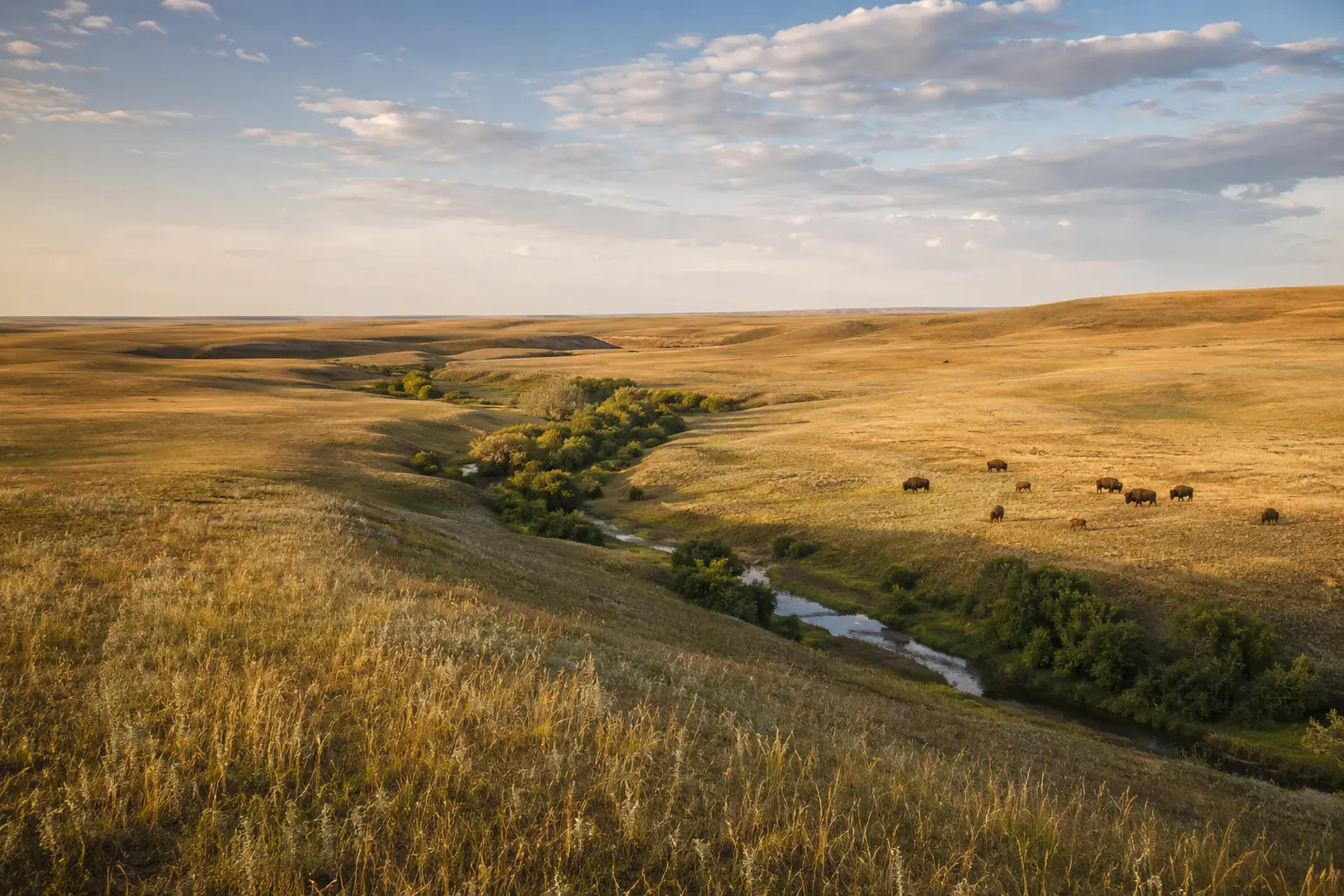
Wanuskewin Heritage Park · Saskatchewan
The prairie keeps
its stories in layers.
At Wanuskewin, a creek-cut valley, archaeological sites, native prairie, and a restored bison herd reveal more than 6,400 years of Northern Plains gathering, movement, and living culture.
PLACEWanuskewin Heritage Park
TIME DEPTH6,400+ years
EVIDENCE19 archaeological sites
LIVING LANDCulture, prairie & bison
Read a cultural landscape
Wanuskewin is both an archive and a living gathering place.
North of Saskatoon, the opimihaw Valley cuts shelter, water, and varied terrain into the open prairie. Its terraces, point bars, and coulee depressions preserve evidence of habitation, bison hunting, tipi circles, ceremony, and return—while Indigenous communities continue to shape how the place is understood today.
 VISITOR CENTRE · TRAILS · BISON VIEWING
A respectful adult visit
Begin with orientation, then let the valley set the pace.
The Visitor Centre introduces Northern Plains histories and contemporary Indigenous art before more than six kilometres of trails descend into the valley. Guided interpretation adds cultural context that a map cannot provide.
- 01
Check the dayHours, seasonal programs, events, and occasional closures can change. Confirm them before travelling.
- 02
Choose one routeTrail of Discovery, Path of the People, Circle of Harmony, and bison routes offer different time and distance commitments.
- 03
Observe with consentFollow photography guidance; Wanuskewin asks visitors not to photograph the Medicine Wheel or prayer cloths.
Walking trails do not permit pets, bicycles, or drones. Bikes can be secured near the Visitor Centre after arriving via the Meewasin Trail.
Four kinds of evidence
Stories survive in relationships, not isolated objects.
An archaeologist records exactly where evidence lies because depth, neighbouring features, soil colour, and association can be as informative as the object itself. The chapter’s “stories in the soil” theme begins with this idea of context.
Stratigraphy
Layers accumulate through deposition, erosion, activity, and time; they are recorded before anything is moved.
Charcoal & hearths
Dark lenses and burned material can mark episodes of fire, food preparation, warmth, or repeated occupation.
Stone placement
Tipi rings, tools, flakes, and patterned features make sense only when their location and relationships are preserved.
Living knowledge
Archaeology is one source; oral histories, ceremony, language, and community interpretation are essential to the whole story.
Why context matters
A careful record keeps a discovery connected to place.
Wanuskewin’s 19 sites occupy terraces, point bars, and coulee depressions across a compact valley. Together, they preserve a record of Northern Plains gathering extending from more than 6,400 years ago to the present.
- LocateMap the exact grid square, depth, and orientation before disturbing the soil.
- DescribeRecord colour, texture, boundaries, features, and nearby materials.
- DocumentPhotograph, draw, and measure so the context survives excavation.
- InterpretCompare evidence with the wider site and Indigenous knowledge, never in isolation.

A keystone return
Bison restore more than a familiar silhouette.
After nearly 150 years away from this land, Plains bison returned to Wanuskewin in 2019 through a partnership with Parks Canada. The herd is a conservation, cultural, and grassland-restoration initiative—not a zoo exhibit.

Different plants and patches receive different pressure.
Hooves press litter, expose soil, and redistribute nutrients.
Dust basins add small disturbances to the grassland mosaic.
Ecology, culture, education, and ceremony reconnect.

LASHING
BASESTRUCTURE IN RELATIONSHIP
Portable architecture
Strength comes from
many parts working together.
A tipi’s long poles lean toward a shared crown while their feet spread into a broad circle. Lashings, pole contact, cover tension, anchoring, and orientation work as one system rather than as separate tricks.
Structure explains how a tipi stands; cultural knowledge explains why, when, and how it is made.
Wanuskewin’s Tipi Village uses 18-foot Plains Cree-style tipis within guided cultural programming. Learn construction and meaning from Indigenous interpreters, and resist reducing the form to a generic shelter diagram.
 GRASS · ROOTS · SOIL · RELATIONSHIP
Plants feed the prairie
Most of a grassland’s architecture is below ground.
Native grasses and forbs invest heavily in roots. That hidden network stores energy, reaches moisture, anchors soil, supports soil organisms, and helps plants return after grazing, drought, and fire.
- 01
Read structureDifferent leaf heights, root depths, and growth forms divide light, water, and space.
- 02
Look for patchinessBison grazing helps create neighbouring short and tall patches instead of one uniform lawn.
- 03
Learn without harvestingJoin an interpretive plant walk to understand food, medicine, fibre, and cultural use in proper context.
Do not pick or collect plants. Respectful learning keeps living relationships—and the prairie itself—intact.
A closer reading of the chapter
Four field notes for the adult explorer.
The supplied character journals are not reproduced here. Their central ideas are reframed as concise, research-backed context for archaeology, bison restoration, prairie plants, and tipi structure.
Object + location + layer → context
Removing a clue can erase its story.
Exact position, depth, neighbouring features, and soil boundaries let archaeologists connect one trace to a larger event. Leave everything in place.
Grazing + movement + wallows → mosaic
Restoration is a relationship.
Wanuskewin’s herd reconnects ecological process with Northern Plains cultural knowledge, ceremony, education, and stewardship.
Deep roots + diversity → resilience
The prairie’s support system is mostly hidden.
Roots bind topsoil, find moisture, store energy, and help native plants recover. Knowledge of their uses belongs within living cultural context.
Poles + lashing + tension → shared load
Engineering and culture are inseparable.
The conical frame is stable, adaptable, and portable, but its deeper meaning comes through Indigenous teachers and community practice.
Find the chapter landscape
A sheltered valley on Saskatoon’s northern edge.
The map places Wanuskewin Heritage Park in the opimihaw Valley near the South Saskatchewan River. Use it for geographic orientation, then open Wanuskewin’s current trail and visitor information for exact routes, hours, programs, and closures.
Exhibits and galleries introduce Northern Plains histories and contemporary art before the trails descend into the valley.
Trail of Discovery focuses on archaeological practice; Path of the People extends through the broader cultural landscape.
Trail of the Bison and the Bison Viewing Trail provide designated ways to observe the conservation herd at a distance.
Wanuskewin trail information and current hours are the visitor authority.
 Read the full chapterOpen Story 5 ↗
Continue the Prairie Adventure
Story 5
Stories of the Prairie
Join Lumi, Aspen, Hazel, and Barrett at Wanuskewin Heritage Park as bison tracks, soil layers, a tipi circle, and deep-rooted plants lead to a carefully recorded discovery—and a new clue pointing toward Hudson Bay.
Opens the chapter page on the main Maple Explorers site.
Questions from curious explorers
Prairie stories, answered.
01Where is Wanuskewin Heritage Park?+
Wanuskewin is just north of Saskatoon, Saskatchewan, in the opimihaw Valley near the South Saskatchewan River.
02What does the name Wanuskewin mean?+
Wanuskewin explains that the Cree or nehiyawêwin word wânaskêwin can be roughly translated as “being at peace with oneself” or “seeking peace of mind.”
03How old is the cultural record?+
Nineteen archaeological sites preserve evidence of Northern Plains gathering and settlement from more than 6,400 years ago to the present.
04Why are Plains bison at Wanuskewin?+
Bison returned in 2019 after nearly 150 years away. The conservation herd supports grassland restoration, cultural knowledge, ceremony, education, and renewed relationships with the land.
05Can visitors explore the archaeological landscape?+
Yes. More than six kilometres of trails, guided programs, and Visitor Centre exhibits interpret the valley. Stay on designated routes and leave every object and trace in place.
06What should I check before visiting?+
Check current hours, admission, event listings, seasonal programming, trail policies, and any site closures on Wanuskewin’s official website before travelling.
Research trail
Official sources behind the field guide
Geography, archaeology, living culture, bison restoration, visitor etiquette, trails, and trip planning were checked against Wanuskewin, Parks Canada, UNESCO, and Tourism Saskatchewan. Confirm current conditions directly before travelling.