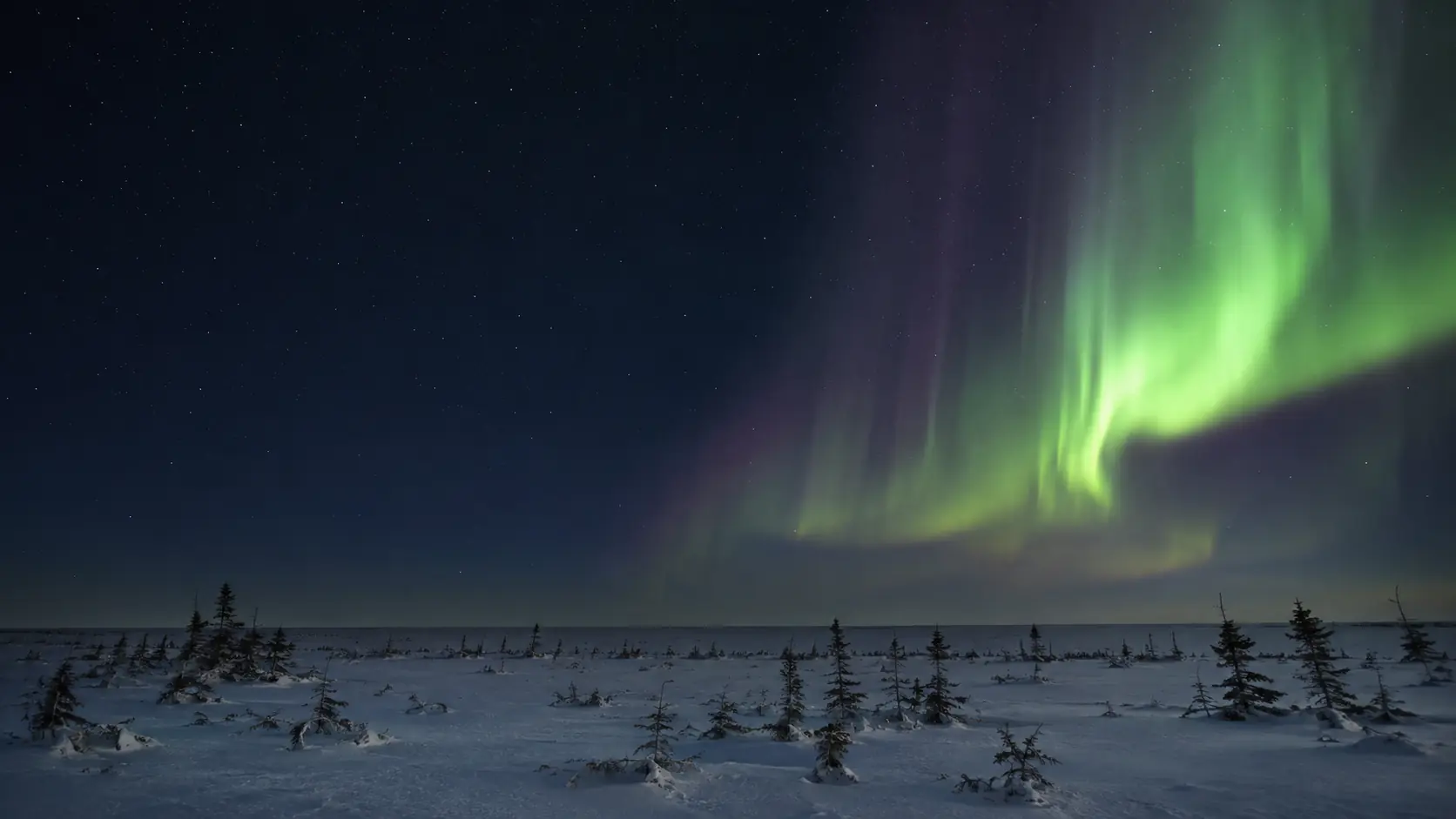
Northern Manitoba · Aurora borealis
When the night sky
becomes the landscape.
Above the Hudson Bay Lowlands, solar particles, atmospheric gases, darkness, and patience combine to produce one of Canada's most arresting natural displays.
CHAPTER LANDSCAPEChurchill · 58.8° N
AURORAL OVALOver 300 active nights
GREEN LIGHTExcited oxygen
ACCESSRail or air · no road
At the edge of the auroral oval
Northern Manitoba makes the sky feel close enough to study.
Churchill sits beneath the auroral oval, where activity may occur on more than 300 nights a year. Seeing it still depends on a second set of conditions: darkness, an open view, clear weather, time outdoors, and eyes allowed to adjust.

Observation is a physical practice
The right field routine helps a faint aurora become visible.
Cold, wind, stray light, and impatience can end a night before the sky changes. A useful viewing setup protects the body while preserving the dark-adapted vision needed to notice subtle arcs and structure.
- 01
Choose shelterUse a marked, permitted viewing location and position yourself out of the prevailing wind.
- 02
Manage moistureStart dry, layer for low activity, and change damp mittens or socks before they pull heat away.
- 03
Protect the darkDim screens and use a low red light only when necessary; bright white light resets night vision.
In Churchill, arrange safe transport or a guide for locations beyond town and follow all current polar bear alerts.
A bird built for the same winter
The willow ptarmigan wears the season.
Willow ptarmigan are year-round northern residents. White winter plumage softens their outline against snow, feathered feet spread their weight, and a compact body reduces exposed surface area. The same feathers that conceal the bird also hold insulating air close to its skin.
- BlendWhite winter feathers reduce visual contrast against snow.
- SpreadFeathered feet improve support on soft, cold surfaces.
- InsulateTrapped air slows heat loss in still conditions.
- FeedWillow buds and twigs remain available above the snow.

The Sun–Earth connection
Particles arrive.
The atmosphere answers in light.
Activity on the Sun sends charged particles through space. Earth's magnetic field guides some toward the polar regions, where collisions with gases in the upper atmosphere release tiny flashes. Seen in sequence, those flashes form moving arcs, folds, and curtains.
The aurora is not light reflected from snow. It is the upper atmosphere emitting light.
The solar wind carries charged particles outward from the Sun.
Earth's magnetic field concentrates activity toward high latitudes.
Oxygen and nitrogen release energy as visible colour.
Colour is a clue to altitude and gas
Green is common. Red, blue, and violet reveal different conditions.
The Canadian Space Agency places green oxygen emissions mainly around 100–300 kilometres above Earth. At roughly 300–400 kilometres, oxygen can produce red. Nitrogen contributes blue and purple lower in the display, while mixtures and camera sensors can make transitions appear pink.
Oxygen, often around 100–300 km.
Oxygen higher in the atmosphere.
Nitrogen at lower auroral altitudes.
Nitrogen and layered colour mixing.
DRY
DARKWINTER FIELD ROUTINE
Cold-weather fieldcraft
A shelter can block wind without trapping stale air.
A low profile and snow wall can reduce wind exposure, but ventilation must remain open. Layers should manage both cold and perspiration, and a warm drink supports comfort without replacing adequate clothing, food, and a conservative turnaround plan.
Know the exit before the lights appear. Weather, visibility, transportation, and wildlife conditions matter more than one more photograph.
Four relationships to notice
Read the winter night as one connected system.
Solar activity, atmospheric chemistry, human vision, and cold-adapted wildlife turn a single evening into a layered field study.
✦ENERGY
The sky begins with activity on the Sun.
Solar particles travel outward and interact with Earth's magnetic environment.
- Sun
- Particles
- Magnetism
◐DARKNESS
Clear weather is necessary; dark adaptation is earned.
A faint arc becomes easier to read when stray light is controlled and the eye is given time.
- Cloud
- Moon
- Screen
- Time
◌EMISSION
Colour records which gas released the energy—and where.
Oxygen and nitrogen glow at different altitudes, producing the aurora's layered palette.
- Green
- Red
- Blue
- Violet
△CAMOUFLAGE
The same feather can conceal, warm, and support.
Winter plumage is not decoration; it solves several survival problems at once.
- Blend
- Insulate
- Spread
- Feed
Questions from curious explorers
Northern lights, answered.
01What causes the northern lights?+
Charged particles guided by Earth's magnetic field collide with gases in the upper atmosphere. Billions of tiny flashes appear to move as arcs, folds, and curtains.
02Why is the aurora often green?+
Green is produced when charged particles excite oxygen roughly 100–300 kilometres above Earth. Oxygen higher up can glow red, while nitrogen contributes blue and purple.
03When is Churchill's main aurora season?+
Activity can occur year-round, but Travel Manitoba and the Churchill Northern Studies Centre highlight the clear, dark nights of January through March. No viewing is guaranteed.
04Why can cameras show more colour than the eye?+
A long exposure gathers light over several seconds, while the human eye reports the scene continuously. A faint aurora may therefore look pale in person and richly coloured in a photograph.
05How do travellers reach Churchill?+
There is no road to Churchill. Travellers arrive by plane or by VIA Rail from Winnipeg or Thompson; schedules and conditions should be checked directly before booking.
06Can visitors hike outside town independently?+
Travel Manitoba advises against exploring on foot outside town without a guide. Churchill is polar bear country, and conditions can change quickly.
Research trail
Official sources behind the field guide
Aurora formation and colour, winter wildlife, Churchill access, regional geography, and visitor safety were checked against Canadian public agencies and northern research organizations. Conditions and schedules change; confirm them directly before travelling.
Find the chapter landscape
Use Churchill as the gateway—not an improvised trailhead.
The official regional map below shows the town, airport, rail line, Parks Canada Visitor Centre, Cape Merry, Thanadelthur Trail, Churchill Northern Studies Centre, lookouts, access roads, and the boundary of the Churchill Wildlife Management Area.

 Read the full chapterOpen Story 8 ↗
Continue the Prairie Adventure
Story 8
Dancing Lights
Join Lumi, Aspen, Hazel, and Barrett in northern Manitoba as willow ptarmigan tracks, a wind-smart winter camp, dark-adapted vision, and a moving aurora point the route toward Churchill.
Opens the chapter page on the main Maple Explorers site.