Family rainforest field guide
Great Bear Rainforest · Coastal British Columbia
Great Bear Rainforest
Forest, salmon streams and remote coastal waterways: discover the habitat of the spirit bear and the careful planning that makes a wildlife journey meaningful.
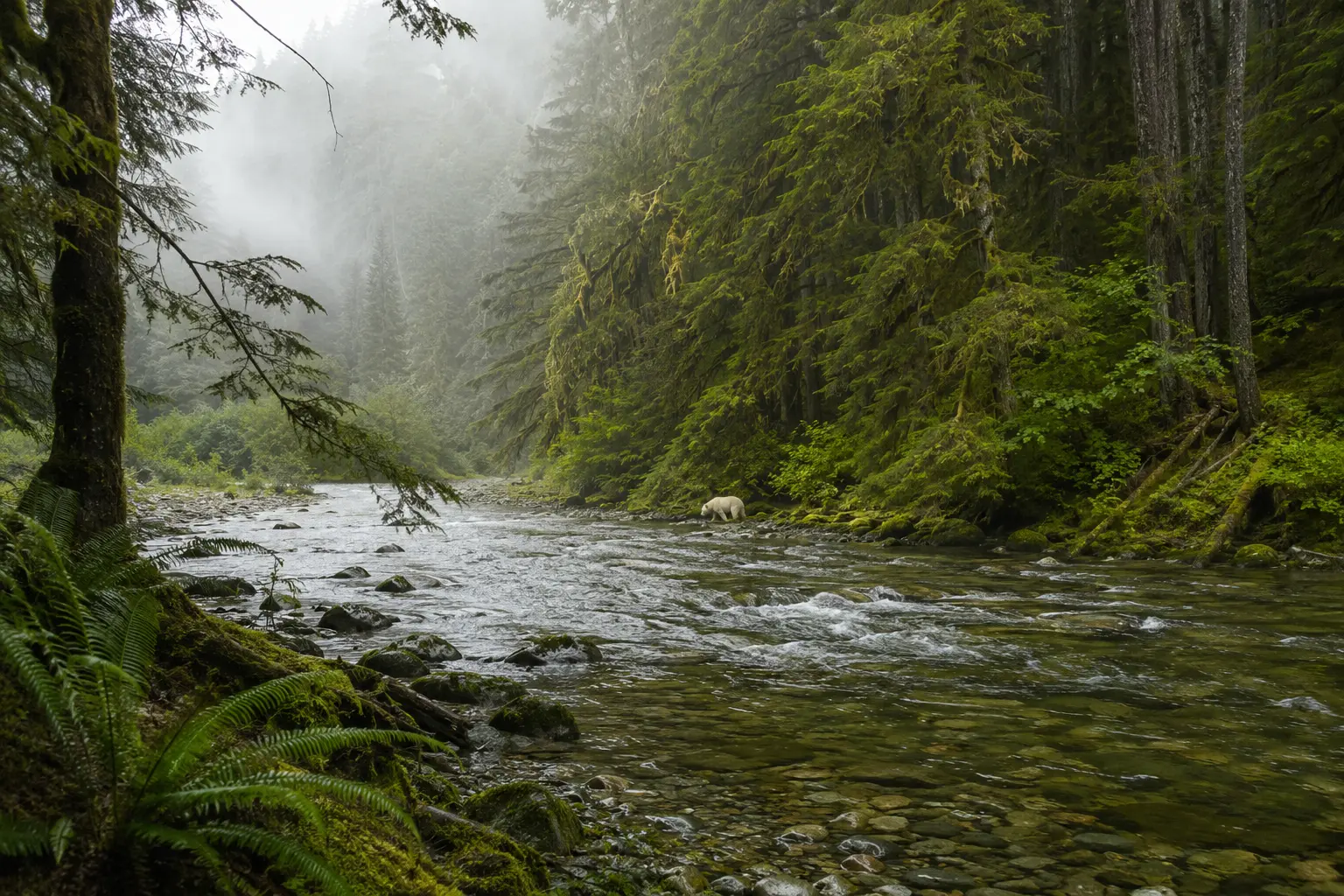
Illustrative destination scene
01Begin with wonder
Great Bear Rainforest at a glance
The possibility of a pale bear is only the beginning of the wonder.
The Great Bear Rainforest is a vast coastal region rather than a single park entrance. Its waterways, forests and salmon streams reward patient observation. Come for the whole living landscape, with a spirit-bear sighting as a possibility rather than a promise.
- The draw
- Coastal rainforest habitat
- The pace
- Guided, patient viewing
- The mood
- Remote-waterway adventure
02Put the place on the map
Where to find Great Bear Rainforest
The Great Bear Rainforest stretches along British Columbia’s central and north coast. Bella Bella and Klemtu are gateways to the spirit-bear region featured here.
Coastal communities reached by air and water.
Klemtu is on Swindle Island, north of Bella Bella. Vancouver is the departure city for the flight-and-boat lodge route below. Port Hardy on Vancouver Island and Prince Rupert on the mainland are regional ferry gateways.
Klemtu lodge flight-and-boat route ↗ · BC Ferries Klemtu connections ↗
- Fly, then travel by boatSpirit Bear Lodge’s Klemtu trips begin with a flight from Vancouver Airport’s South Terminal to Bella Bella, followed by a lodge-boat transfer north to Klemtu.
- By coastal ferryBC Ferries sailings link Klemtu with Port Hardy and Prince Rupert. Central-coast connector services also link the area with Bella Bella and neighbouring communities.
Province overview
British Columbia

Bella Bella is a central-coast gateway within a much larger rainforest region.
A closer look
Great Bear Rainforest · central-coast focus

- Featured location
- Key road
- Water
Open enlarged local map ↗ · Example: a Klemtu operator’s arrival guide ↗
Geographic orientation with selected landmarks and roads. Road geometry is mapped; this is not a turn-by-turn route or a record of current access.
Map data © OpenStreetMap contributors ↗ · Province and regional outlines: Natural Earth ↗. Maps prepared 21 October 2026.
03Three ways to look closer
Learn and explore in Great Bear Rainforest
Understand an unusual coat, ask how observation spaces can reduce disturbance, and use a simple model to explore inherited variation.
- Nature spotlightMeet a forest-connected bear ↗
Look beyond colour to food, streams and habitat.
- Engineering spotlightDesign for quiet observation ↗
Consider sightlines, controlled movement and the needs of wildlife.
- Science spotlightExplain a pale coat ↗
Separate genetic inheritance from the idea of camouflage.
Start small: Choose a question that does not depend on a sighting: what links the stream, the forest and the animals using both?
04Spirit bears & rainforest ecology
A bear belongs to a whole habitat.
Spirit bears are American black bears with a pale coat. They share the broader needs of coastal black bears: food, space and connected habitat.
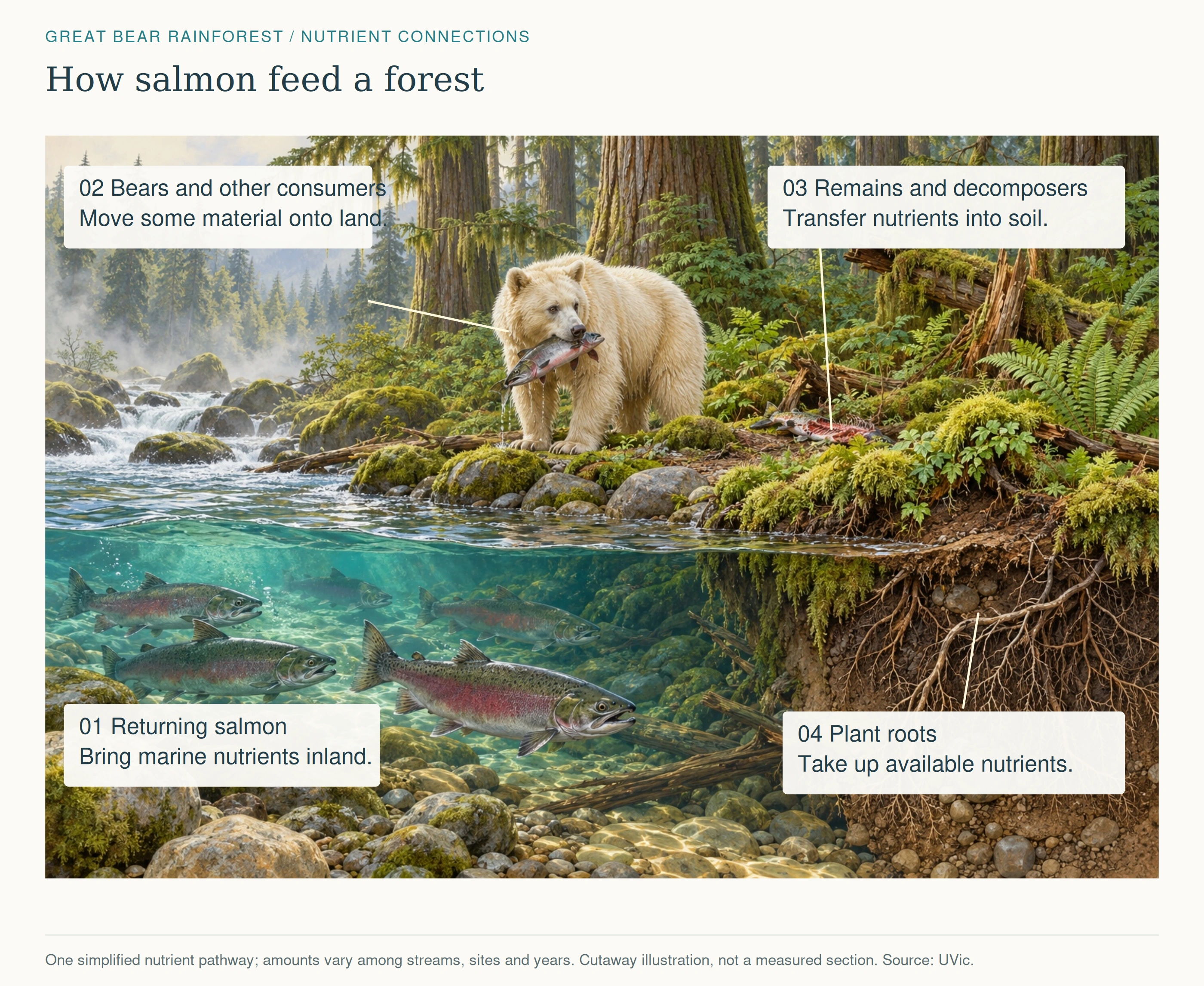
- Streams connect ocean and forest.
Returning salmon become food for coastal bears. Fish remains and waste can move marine-derived nutrients into terrestrial habitats.
- Look beyond the rare encounter.
A salmon stream, a mossy trunk or a bear track can open a useful ecological question. Never approach wildlife or search for a closer view without your guide.
Try this: Use the illustration to trace a possible connection from salmon to bear to forest. A teaching illustration shows a relationship; it does not measure how much nutrient reaches a particular tree.
UVic: the Salmon Forest Project ↗ · Local operator: viewing context ↗
05Observation-space design
Build the view around the wildlife.
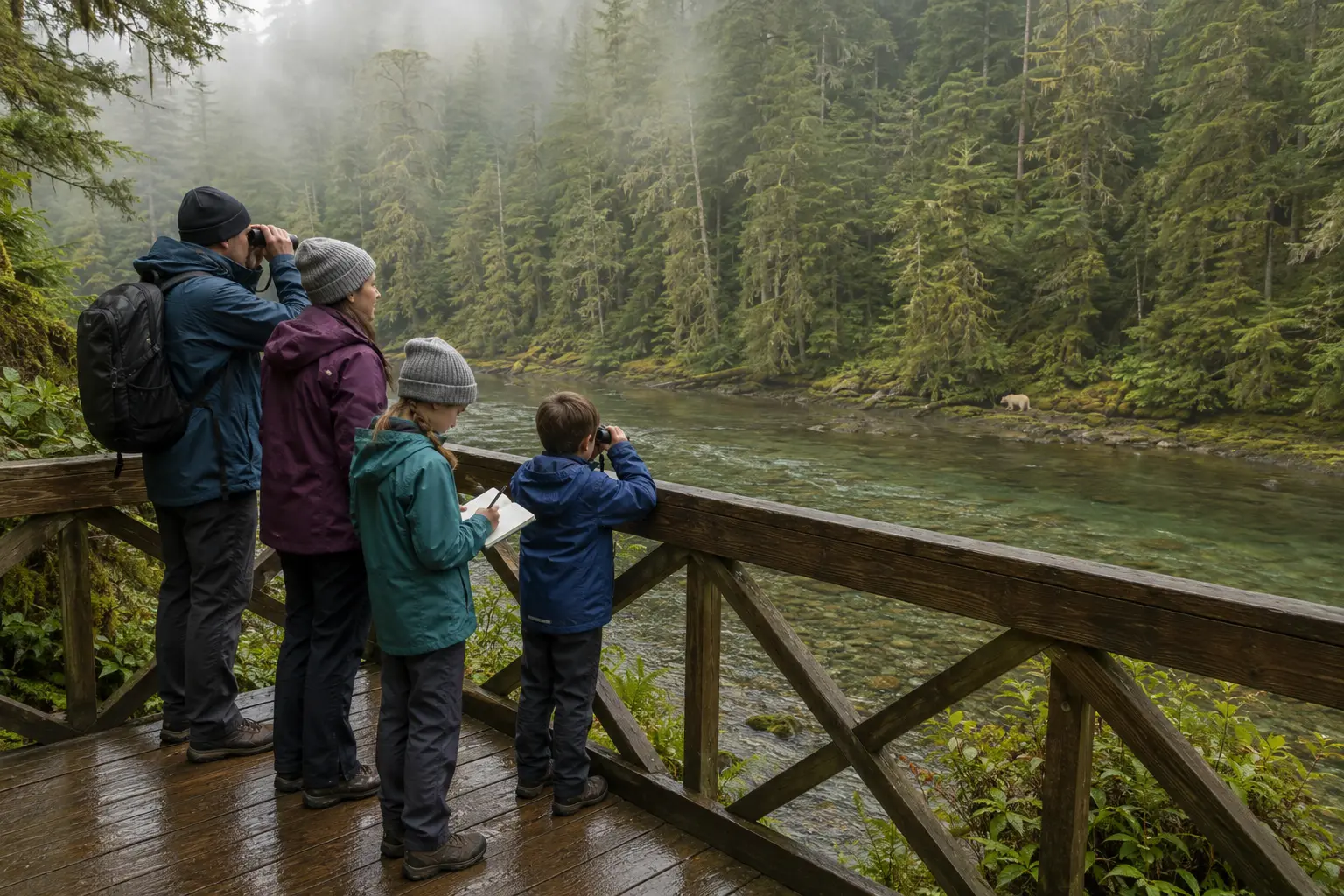
A viewing platform or screened observation space can organise where people stand and which direction they look. Its design must consider both people and the animals whose habitat surrounds it.
- Control movement and sightlines.
A defined standing area, appropriate rails and a clear viewing direction can help a guide manage a group.
- Fit the site.
Ground conditions, drainage, loads and maintenance matter. An attractive drawing cannot establish that a structure is safe or suitable for a real location.
Try this: At home, sketch an observation space with an entry, a standing area and a viewing direction. Ask where people might bunch together and how the design could keep movement calm.
01 · People
A clear place to stand
Plan the group’s space and the way people enter.
02 · Wildlife
Room to choose
Keep the observation idea separate from pursuit or feeding.
03 · Site
Water and ground
Consider drainage and local conditions before any real construction.
04 · Care
Inspect and maintain
Real structures require professional design and ongoing inspection.
06Inheritance & camouflage
How can dark parents have a pale cub?
Coat colour and camouflage are different questions. Inheritance explains how a cub receives a pale-coat variant; visibility depends on the observer, background and light.
Illustrated field lesson
A pale coat can be inherited.
Appearance and inheritance are related—but they answer different questions.

- Same species
Dark and cream-coated spirit bears are American black bears.
- Hidden carriers
A dark-coated parent can carry the recessive pale-coat variant.
- A conditional probability
For two carriers in the simplified model, each cub has a 25% chance of aa.
- A recessive variant can be hidden.
In a simplified single-gene model, two dark-coated carriers can each pass on the pale-coat variant. A cub receiving that variant from both parents can have a pale coat.
- Camouflage needs evidence.
Research on coastal bears examines coat colour and foraging. A pale bear looking conspicuous to a person does not tell us exactly what a salmon sees, or prove why the trait evolved.
Try this: Read the model below as possible outcomes for each cub. A one-in-four probability is not a prediction that every litter of four will contain one pale cub.
Read the inheritance model as a table
Aa × Aa: a simplified inheritance model
A = the dark-coat variant in this teaching model; a = the recessive pale-coat variant. Both parents are dark-coated carriers.
| Parent variants | A | a |
|---|---|---|
| A | AADark coat | AaDark carrier |
| a | AaDark carrier | aaPale coat |
Each cub has these probabilities independently for this pairing. This model does not predict the exact make-up of a litter.
07Make the day work for your family
Family travel guide
A flexible plan, useful official links and enough time to enjoy the place.
Begin with suitability, then book the journey.
Ask the operator about minimum ages, quiet waiting, boat transfers, walking conditions and the length of field days. A family-friendly description is not enough to establish whether a specific itinerary suits your children.
Confirm boarding arrangements, steps, terrain, toilets and any mobility accommodation directly. Remote travel also needs flexible connection plans; leave room around flights and transfers rather than building a tight onward schedule.
When to go
Before booking
Choose an operator whose dates, age policy and activity demands fit your family. Ask which seasonal wildlife opportunities are realistic.
Summer into autumn
Some bear-focused itineraries follow salmon seasons. Confirm the actual operating dates; neither a month nor a booking guarantees a spirit bear.
Outside the viewing season
Do not assume a self-directed visit is an alternative. Confirm transport, services and authorised access before committing.
Bring a small field kit
- Layered clothing
- Operator-approved rainwear and footwear
- Personal medications
- Binoculars; quiet camera settings
- Waterproof protection for belongings
- The operator’s own packing checklist
Is there a road to a spirit-bear viewing site?
Do not plan this as a roadside attraction. Select a hosted itinerary and confirm its transport and access arrangements.
Will we definitely see a spirit bear?
No. Plan to value the habitat, local knowledge and other observations regardless of whether a pale bear appears.
Sources & image notes
- Research: spirit-bear coat colour ↗
- Example: a Klemtu operator’s arrival guide ↗
- UVic: the Salmon Forest Project ↗
- Local operator: viewing context ↗
- Operator: guided wildlife observation ↗
- Peer-reviewed research: genotype and foraging ↗
- Example arrival itinerary ↗
- What a guided viewing day involves ↗
- Current tour details and booking questions ↗
- Road conditions for any road portion ↗
Destination scenes are existing learning illustrations, not documentary photographs or records of a visit. Province overviews use Natural Earth boundaries and local maps use OpenStreetMap road, water and named-place geometry; they do not establish current access. Seasonal suggestions are editorial planning advice.
Reference and planning links assembled 19 October 2026. Check the relevant authority for current access and operating information before travelling.
The illustrated field lesson combines contextual artwork with checked explanatory labels. It is a qualitative teaching model. Its main labels are repeated in readable text below the figure.
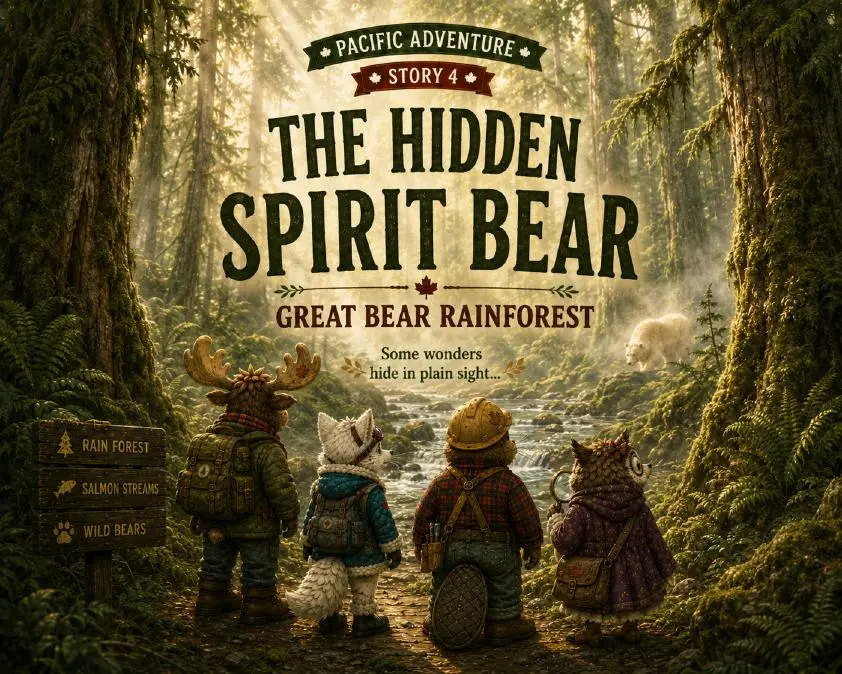
08 · Read the children’s story
Take the wonder into the story.
The Hidden Spirit Bear
Enter a rainforest adventure about a rarely seen bear, close observation and the surprising science behind a pale coat.
Read together before your visit to spark questions, or afterwards to compare the discoveries with your own.
Read the children’s story ↗Pacific Adventure · Chapter 4